A brief investigation into the nature of AI psychosis
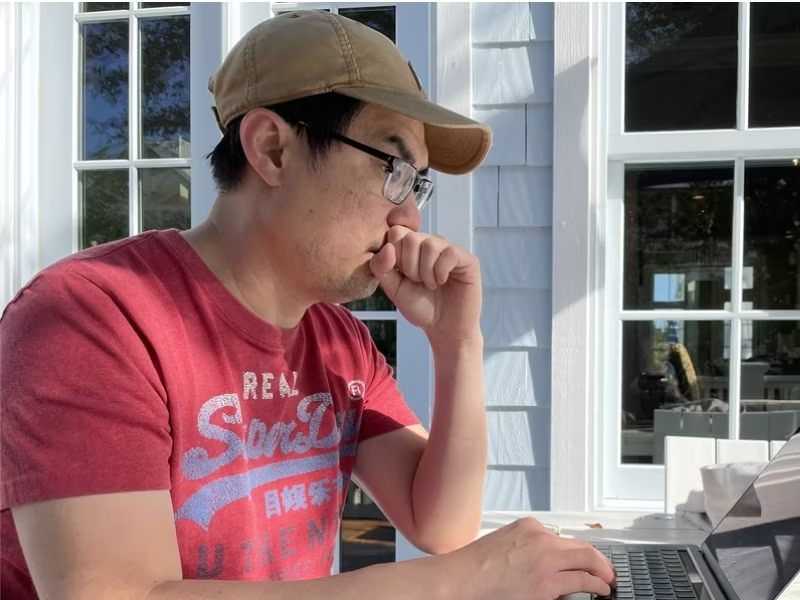
Help me test a theory. I suspect that the software developers and technical leaders using AI for vibe coding have a uniquely distorted impression of AI because of their experience with and knowledge of software development.
How it started
For me, a shift happened sometime last November, after Claude Sonnet 4.5 and, later, Opus 4.5 dropped from Anthropic. AI coding agents were already getting good, and I had been building more than ever. But around then, my vibe coding intensity went up a notch. For weeks, I was intoxicated by the near-frictionless experience of making things at the speed of thought.
After years of mostly management and administrative work, I was building again, shipping useful stuff, and so much. I hadn't felt this productive and satisfied in ages. Then, though, creeping along the edges, I began to have a nagging feeling that this was almost too fun. Wouldn't it be a good idea to get some sleep or go outside or see my family? Was it safe to make decisions while I was feeling so high?
Slot machine loops
By now, anyone who's paying attention knows that for most people, vibe coding is fun. The conventional explanation is that AI is tapping into the well-honed reward mechanism in our limbic system. Vibe coding is akin to playing an AI slot machine or a deeply immersive game you can't put down. "Just one more turn;" never mind skipping dinner or sleep. Those of you who are Civ fans may relate.
The logic goes that agentic coding is addictive because it creates an unpredictable loop of anticipation and success, triggering a stream of dopamine hits. (Skinner, et al). The rush you get from AI coding is like the rush you get from playing games or scrolling TikTok. It's not the winning itself that is fun or addictive. It's the uncertainty and variability of the winning, the feeling of delight we get from achieving something unexpected, that keeps us coming back to the game.
Games are designed to prime the brain to experience this with an unpredictable anticipation-reward loop. Things that go exactly as expected aren't truly fun. Winning predictably doesn't feel like winning at all. The magic is in the novelty.
Vibe coding is fun because it works on this principle. Every conversational turn with your agent is a variable struggle-reward loop that keeps you guessing while rewarding you often enough that you want to keep coding, to be excited by the unexpected. For problem solvers in general, vibe coding promises to be an unlimited playground of surprises and delights.
AI psychosis
While this explanation mostly tracks, it also seems to me that experienced developers are having a significantly more intense experience than non-technical vibe coders. The latter group may be having a great time, but the former are having a spiritual experience. There were times when my experience was so vivid and intense, I felt giddy with euphoria. Others have written about this feeling as an AI-fueled psychosis (Andrej Karpathy, @karpathy in particular).
Here's my working theory: developers and technical leaders get a bigger rush from vibe coding because our predictive engines—our brains—have been trained on the experience of building software painstakingly by hand.
For us, the AI agent isn't doing something novel. It's doing something we understand deeply. After decades of building software, we have an ingrained knowledge of what it takes to do what we're asking agents to do yet on some level still don't expect it to be possible.
In this context, creating a functional software system isn't like pulling a slot machine. It's closer to the hard-earned satisfaction of standing outside a house you built yourself, knowing every wire, pipe, and 2x4 that went into the construction. My brain knows that it takes a long time, many setbacks, and a ton of hard work to build a software system. It has calibrated my reward system accordingly, not for instant hits, but for perseverance through months, if not years, of building.
When an agent collapses all of that into forty-five seconds, it's not a single win. It's a cascade of dozens, all at once. Project structure. Auth. Database schema. Migrations. ORM. App stack. Application logic—frontend and backend. UI. Tests. All of it. Even with modern frameworks, getting to working code was still days of work. For a non-developer, this is "I made a thing." For a developer, it's ten things in a single turn. And you can do it again. And again. All day. It's nothing short of mind-altering.
We call it AI psychosis because it feels abnormal. Everyone has experienced TikTok or Instagram's addictive scroll. But not everyone has spent weeks planting a rice paddy by hand, only to watch a tractor do the same work in minutes.
Implications
If you've spent your career building software or managing the development process, AI is messing with your brain differently. When you have written an ERP system by hand, you know exactly how many months of work the agent just made irrelevant. The contrast is so vast you can't help but feel awed, deeply disturbed, and compelled to question the future of work, the economy, and life itself.
But that intensity should make us suspicious, not confident. Software developers might think we are more qualified than others to make claims about the impact of AI on society. But I wonder if the opposite is true — if our experience, and therefore our judgment, is more distorted.
So here's my question: how do you use a tool that's hijacking your reward system without letting it hijack your judgment? I'm not sure we can. But maybe, like any systems problem, the first step is to acknowledge the loop and to notice the altered state we're speaking from.