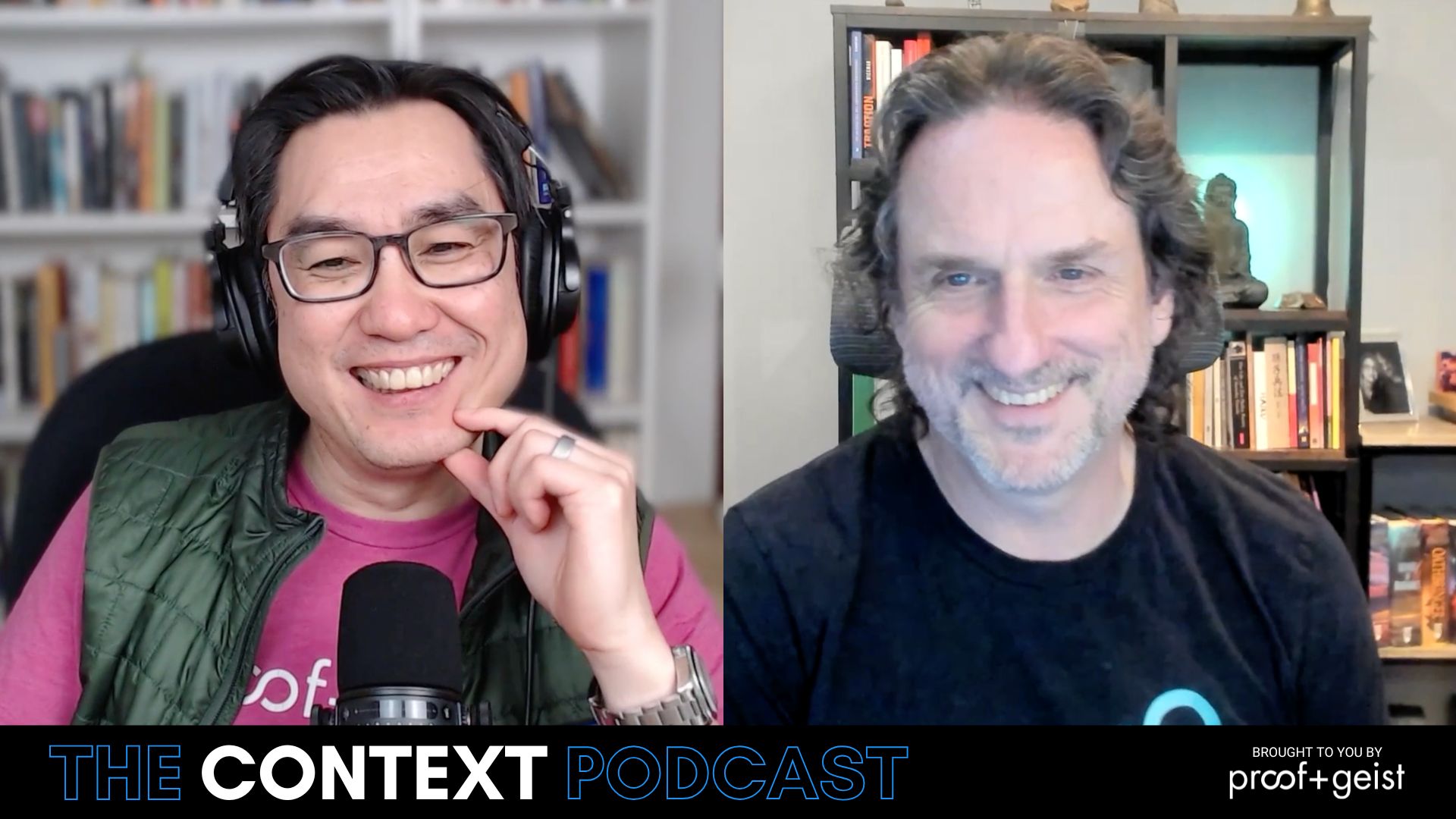
The Context Podcast: FileMaker, AI, and ProofKit
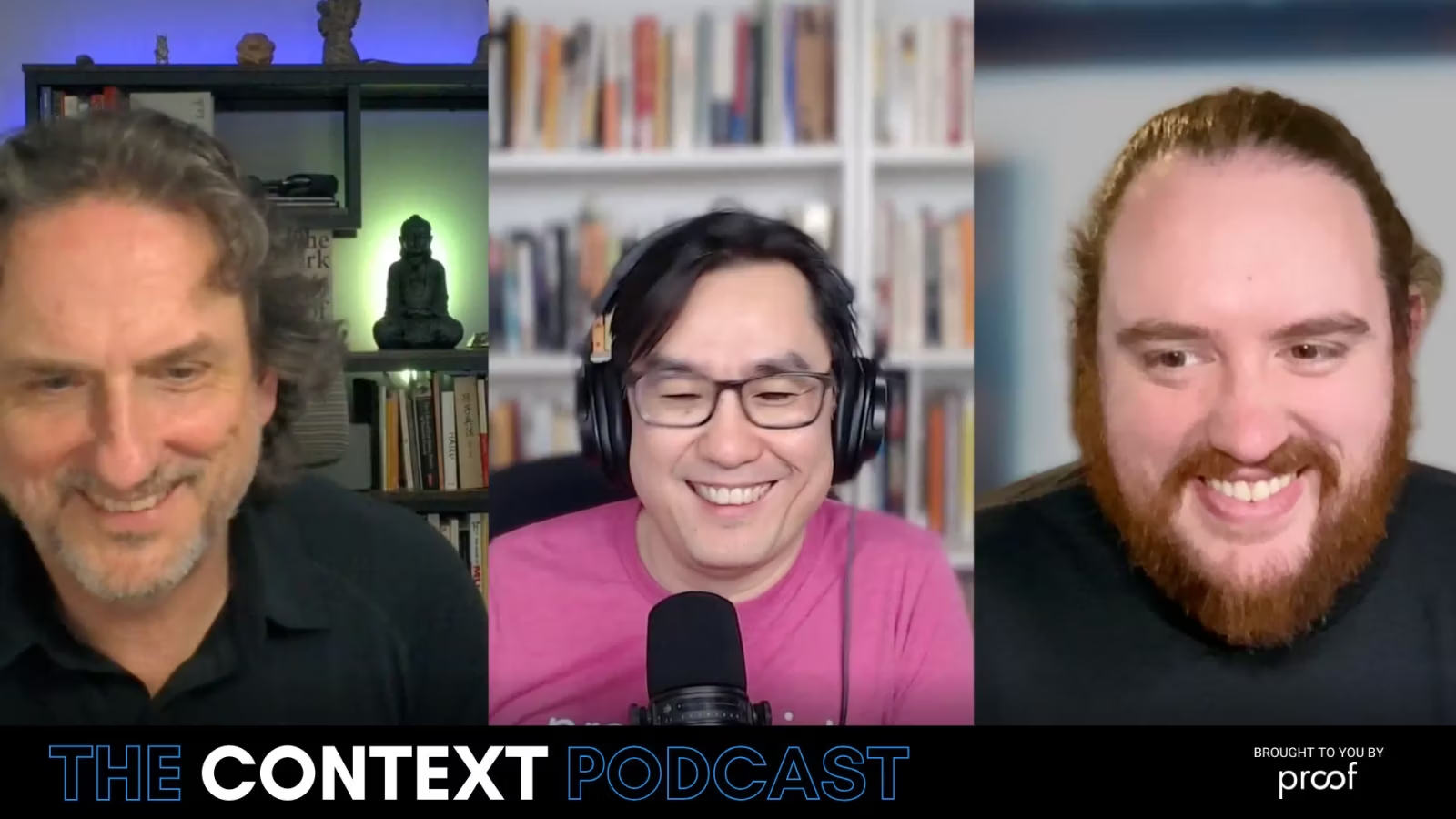
Featuring:
- Ernest Koe, CEO of Proof
- Todd Geist, CTO of Proof
- Eric Luce, Sr. Software Engineer
Description:
In this episode of the Context Podcast, Ernest Koe, Todd Geist, and Eric Luce dive into This Week in AI: FileMaker Edition. They explore Claris’ strategic pivot and the evolving core value proposition of FileMaker within the AI engineering era. The team also introduces ProofKit, our new toolkit for agentic FileMaker development, discussing how we’re sharing it with the world. Tune in to understand why navigating this AI-driven landscape—filled with both immense opportunity and complex security risks—is more critical than ever.
Interested in ProofKit office hours? Share what you’re building with ProofKit on social media, and email us a link! We’d love to chat about what you’re using it for.
You can view this podcast on Youtube, Transistor.Fm, or your favorite audio platforms.
Featured Links:
- Ryan‘s Blog Post: How Claris is building for what comes next.
- Richard Cartlon’s podcast: What Comes Next: FileMaker & AI with Ryan McCann
- Video: Build a FileMaker Web Viewer App in Under 10 Minutes with Cursor + ProofKit
- Proof Community
- Ernest’s Blog Post: A brief investigation into the nature of AI psychosis
- ProofKit
- ProofKit’s YouTube playlist
Ernest Y Koe (00:03.608)
Let's see, are we recording? Looks like it. All right.
Todd Geist (00:05.496)
We are recording, we're live. So we should pretend like we know that that's happening.
Ernest Y Koe (00:11.096)
Welcome back to another episode of the Context Podcast. I'm Ernest Ko, and I have Todd Guise and Eric Luce. I'm going to talk about a few things today. think on deck are, there's been some interesting things happening in the AI world and in the Claris FileMaker world. I think Ryan and Ryan McCann, Claris CEO, posted a blog post recently signaling where they are going with AI and FileMaker. We should spend some time on that.
And also, I think that we've been hearing quite a bit of stuff around this like anti-AI vibe that's happening. People getting booed about AI, layoffs by, know, nasty messages from CEOs and the light. And maybe we can spend some time on that. And last but not least, there's a lot of exciting things around ProofKit that we want to share. And maybe there are other things that come up, but I think those are the three. Yeah, that's right.
Todd Geist (01:05.059)
And it also ties into Ryan's post too as well. yeah. So you want me to share this, the post up here and we can talk about Ryan's thing first?
Ernest Y Koe (01:08.642)
Yeah, yeah, yeah, that's good.
Yeah, let's start with that. Let's start with Ryan's post because I think that is a inflection point in our community and we should talk about it.
Let's see, so this came out when May 5th.
Todd Geist (01:28.376)
came out May 5th. Here we got, here's a picture of it here. How Clarice is building for, for what's next. So there was this blog post and then a few days later he did a video interview on Richard Carlton's live stream, which was quite interesting. Gave a little more details behind the, behind the story here. But yeah, so basically,
Eric Luce (01:30.824)
you
Todd Geist (01:54.702)
you know, the statement from them is writing code used to be the hard part, it isn't anymore. And in terms of a Clarus ecosystem, you know, one of the things that Clarus always had was it was this rapid development environment. And we were able to write working solutions very quickly without having to, you know, learn complex programming languages and things like that. So for many years, especially in the early days, FileMakers bread and butter was the fact that
it was the easiest way to build really good complex business systems. It was easy. And the big change is that's easy for everybody now, is basically to write the code, the implementation, the code on the page or the code in the binary is no longer the hard part to do. And that's a pretty big shift. And it seems like Ryan and Clarice has recognized that and they're taking some steps to respond.
Ernest Y Koe (02:55.061)
I mean, I obviously think that this is absolutely the right thing to do. think, what did Ryan say? Let's crystallize it. So what's happening in FileMaker is that FileMaker is the foundation, they are going to be making FileMaker a first class development target for agent-encoding tools, starting with interface, and then moving on to scripts and schema and other things that we can modify. We should talk about this idea.
what does that mean? What is the first class development target inside an agent decoding platform? Cause I think this is not the same thing as bringing AI into file makers per se.
Todd Geist (03:33.74)
Right, right, right. And that was kind of what people wanted to do at first was to have a little coding editor next to them in Scriptmaker. And we felt that wasn't the right response pretty early on because we were already using tools like Cursor and Claude. And I think that crystallized over the last few months that you really just need agents to have access. And yes, it might be nice if you have an agent that's finely tuned for your particular environment, but the first thing you need to do
Ernest Y Koe (03:37.099)
Right.
Ernest Y Koe (03:41.014)
Right.
Todd Geist (04:03.04)
is give your development environment, your deployment target, the ability to be coded and to be edited with by agents, right?
Eric Luce (04:15.803)
Yeah, I think you guys have talked about this in the past, right? Where like the point is the agent has to have access to the full loop. That was the first like turning point for me when I first started doing anything with AI coding was in cursor because cursor could, or the whole agent could see the errors that the code was producing and immediately fix itself. And there was no more going back and forth between I have to copy this error from my browser and paste it back into ChatGPT. That happened automatically.
the result is a working code at the first time you tell it to build something, usually.
Ernest Y Koe (04:50.219)
Right. I think it's really important to note that we're using the word agentic and agent here very intentionally and deliberately, right? Because it's not, the one way to think about this, I mean, think there's a way you can think about this where, you know, the AI is just a model that you are chatting against. And then if the, if the model can do something, then, then that's it. You know, that you've got, you've got AI and you can deploy it anywhere. But the reason
Coding agents at coding agents is not because it's a dumb interface talking to a smart model. The smart model must exist. That's true. Frontier models, Opus 4.7, GPT 5.5, whatever, Composer 2.5, all those things are important. But the agentic loop, the harness that allows that experience, that looping thing that you're alluding to, Eric,
and its ability to correct and reason, that is what really makes the coding agent an agent. So it's not sufficient to just jam an LLM in the model into some UI and say, hey, now you've got chat and you can write code, too, agentically. That's a different, that's a substantially.
less good experience than what you would be getting from Claude and all the other things that we're seeing today with coding agents.
Todd Geist (06:20.494)
Right. And I think that that's, that is the key, like closing the loop, giving the agent the ability to see what it, to see the output of what it's doing and verify it itself. Once you do that, then that's actually kind of what happened in December of 2025 is that the, those dots were all connected and people realized that you could basically just loop as long as you provided the proper feedback to the agent, it would figure out the right thing to do. Right. And because before that,
Ernest Y Koe (06:33.686)
Right.
Todd Geist (06:48.78)
you were having to guide it and watch every step and correct along the way. And now they've become self-correcting. And so that's really key. So what we're talking about here is that in the poster, you're talking about building for FileMaker with the AI tools you choose. And I think that's really important because people have favorite agents. I tend to use Cursor and Claude quite a bit. I think Eric uses Codex quite a bit. I don't know, what's your favorite daily driver these days, Ernest?
Eric Luce (07:13.293)
I do, yeah.
Ernest Y Koe (07:16.487)
I'm in Claude land. I'm having a lot of fatigue of switching around, suffering from like, you know, trying to try this agent and this model and that. so I feel like I've gone backwards in many ways and I've refactored my environment so many times that I'm now resolved to just sticking with Claude Claude code and mostly Opus 4.7 for most of what I do.
Todd Geist (07:29.368)
Yeah.
Ernest Y Koe (07:43.639)
But I think it's different. The range of stuff that I do on a daily basis tends to span from operational things all the way to coding things. So that probably works well for me. I can imagine that most of our engineers and developers may just want to live in Cursor or in Codex as the happy place.
Todd Geist (08:07.992)
Yeah, what I tend to do is write, you know, I tend to use Claude as more like the old chat style doing research. And then I use cowork is kind of like an agent framework to get automations done. And I use code also. But I think primarily when I'm coding, when I'm really deep in coding, I'm using cursor. And one of the reasons is I really like Composer 2.5. It's very, very fast. In fact, there's a video, we'll point this out later where I show cursor.
Ernest Y Koe (08:15.988)
Hmm.
Ernest Y Koe (08:30.602)
Yeah, it's nice.
Todd Geist (08:37.486)
building a FileMaker web viewer app in about 10 minutes. It's just one shot, one prompt all the way through. I think it's one prompt, maybe two. And it does the whole thing in like 10 minutes. It's really, really, really fast. Much faster than Opus, which tends to think a lot.
Ernest Y Koe (08:54.966)
Right, tends to think a lot and burn a lot.
Eric Luce (08:56.069)
I thought it was even faster than that, but yeah, like 90 seconds initially. Yeah.
Todd Geist (08:58.778)
It's really fast. Like it gets to like, it got the project set up in like under two minutes. Like it just blew through it really, really fast. So we'll have a link in the show notes about that video and you can go watch it. So anyway, I like to do a couple of different things there, but anyway, the main point is I hope that's obvious from the three of us using really have three different favorites is that you really, if you're going to say to somebody, Hey, agentic coding, but you got to use our agent.
Eric Luce (09:06.574)
Yep.
Todd Geist (09:28.888)
people are going to go, I like my agent. know, like, this is they're going to do. They're going to do it. You're going to have favorites. And so I think that was one of the big breakthroughs that happened in, happened in the last four to six months. And I think probably a clarist too, is I think they realized that they didn't have to build an AI agent into FileMaker, which would have been a much, much, much more difficult job. And they could just use the coding agents that everybody else was doing and, and just hook into them, which I think is the right, the right move.
Eric Luce (09:58.4)
It lets people choose, but it also lets them update. If you want to switch models, you can. You have total freedom there for whatever you need to do.
Ernest Y Koe (09:58.412)
Right.
Todd Geist (10:03.02)
Yeah, right. Yeah.
Ernest Y Koe (10:06.41)
Yeah, it's not just about switching models, right? It's about choosing agents. I'm sure you use OPAS in cursor. I mean, I use other agents actually in Cloud Code too, occasionally when want to model agents and everything, right? I know we're geeking out on agents and models here. But I think the important point here with Klairs and what's happening is that this is a break. I think there was.
Todd Geist (10:15.82)
I do sometimes, yeah.
Eric Luce (10:19.044)
Yeah, models, agents, everything, can have all the, yeah, you get to choose.
Todd Geist (10:21.934)
Yeah. Yeah.
Ernest Y Koe (10:32.694)
FileMaker was always about trade-offs. And any development environment was always about trade-offs. We make trade-offs to get more power, more speed, more access, all kinds of stuff. And FileMakers just happened to be a really good sweet spot where you could get enough capability and power, also to get people who are non-technical programmers
problem-solving platform that they can bring solutions to the business more quickly. And that gap has certainly closed dramatically in last few months. I mean, it's clear that problem-solving in any way the coding agent is now accessible to most people. So the core value proposition of Almegar needed to change.
Todd Geist (11:14.19)
Yeah, for sure.
Todd Geist (11:28.642)
Yeah, absolutely needed to change. I don't, there's a, there's other things here and what's coming in the, future and what's next. All, all important. I'm talking about the interfaces, which is obviously his is what proof kit is all about also scripts and schema. they, so they get where the problems lie. We're going to talk about proof kit a little bit later, but maybe we should just say now what we think of this announcement in relation to proof kit and
and sort of how we see those two things combining. Does that make sense?
Ernest Y Koe (12:05.331)
Well, I I think this sets up ProofKit quite well. I mean, I think this vision of what FileMaker is is exactly the vision we hope FileMaker and Klairs adopts, because this is exactly what ProofKit is counting on, right? ProofKit. But maybe it's worth talking about how this is different or the same as ProofKit. That could be a way in.
Todd Geist (12:19.982)
That's right. Yeah.
Todd Geist (12:27.982)
Yeah, like I think it might just help that there's a lot of technical details that actually don't matter. And implementation details are what they are. But we had to build, we had to do a bunch of things because we can't write code directly into the FileMaker Pro. So we had to do a bunch of things to kind of make this work to where we can build web interfaces. And what we're hoping and what it looks like based on what we know is that
lot of those things we won't have to do anymore. Clarice will have it baked into the product. And so then whatever things that we're doing, that are different or more advanced or more, you know, maybe differentiated based on other things we have, like our automatic platform, for example, we can just use those things that they've baked into the, into the product itself. We did this very similar thing with, with, with auto FMS, the first version of auto FMS, which was called auto.
there was no admin API on the file maker server. So we had to create our own admin API. That was one of the, one of the key things that auto version one, two, and three provide, or one and two provided was, was an admin API that you could use. But the minute Clarice shipped an admin API for file maker server, we just dropped it and moved to that. And so I expect that proof kit will just do the same thing. We will just use whatever hooks and capabilities.
that that Clarice makes available for us to continue to do proof kitty like things, if that's a word. But we have some ideas. There's lots of ways we can take this further. But it'll be nice that we can offload that part of the engineering where it's like things that really belong baked into the product itself. We don't have to deal with that anymore. We can only deal with the with the stuff that is maybe more opinionated. An example might be that we could do.
Ernest Y Koe (14:03.511)
I'm just kidding.
Todd Geist (14:24.96)
integration with our automatic hosting platform that wouldn't make sense to be in the Claris part of the thing. But now because we don't have to do that part, we can spend more time on other types of integrations and things that make more sense for us and our customers.
Ernest Y Koe (14:31.029)
Sure, yeah.
Ernest Y Koe (14:39.391)
But also, there is this layer, this open source layer of ProofKit that is sort of the collection of opinions and ideas and stack and libraries that we've accumulated over the years that allow us to work this way. And Kaliress could have their own set of opinions that ship that we either adopt or don't adopt. And that's kind of the beauty of this whole paradigm. So ProofKit could exist in a happy.
co-exists happily with whatever Clarisse does to support the proof kids of the world and different ways of agentically developing and farming.
Todd Geist (15:22.434)
Yeah, so it's very exciting. We're thrilled that they're doing this and we're excited to see what they do. So yeah, anything more to say on that? think that might be enough on that topic. Anything more?
Ernest Y Koe (15:38.836)
No, I mean, I think it's really aligned with what we're doing at Proof. And I think maybe just a thought here. I think this really matters for businesses and people who have invested in FileMaker. I mean, think the story tends to be very techie and focused on the technology and developers. But what's really exciting for me is that it really allows the investments that
Todd Geist (15:52.184)
Right, sure, yeah, good point.
Ernest Y Koe (16:06.773)
people have made in FileMaker to have a whole new life beyond its current way of doing things. We're joining basically the AI economy in a very real way. mean, this is like FileMaker will be able to take advantage of all the AI coding powers that developers can bring to bear. And you'll have access to more capability and more skills. Anything in the whole open marketplace now is now available to FileMaker.
You know, so as a business, if you're looking at this and say, how does this matter to me? You know, so what if, well, just think about this. I mean, if FileMaker was stuck in the old way of doing things, artisanal programming, where you have to hand code and hand write every single thing, and your layouts are stuck in the old style, know, FileMaker layouts, and it's not responsive, it doesn't work across, you know, across devices and browsers and all that stuff, you might be very tempted to say, yeah, we can't stay here very much longer because
Now we've got a different way of doing business, and we've got to go and bring AI into the company. And now you don't have to do that. And not only that, all the things that you thought you had to compromise with FileMaker before for speed, but not get the fancy layouts, those things are all gone away.
Todd Geist (17:30.412)
There the so that's a good point. I want to just piggyback off that one last thing there. I mean, just to be very, very clear, we're so happy that Clarice is doing this because. I mean, we think proof gets pretty great, and it's going to be great for our customers and for the the services teams that we support to build great apps in FileMaker. But it's going to be it would be very difficult for us, even though we're a platinum partner.
to chip that value to the entire ecosystem because it's a big ecosystem, it's huge. Believe it or not, there are companies out there that have never heard of us.
Ernest Y Koe (18:04.809)
debate.
Ernest Y Koe (18:08.788)
That's true.
Todd Geist (18:11.82)
Which is, which is both exciting and kind of a shame, but I love that that people can still discover us and get excited about what we do. But still, I wish everybody in the, in the file maker ecosystem knew who we were. But so by Clarice backing this, this actually means the whole ecosystem goes along for the ride. And that's really important ultimately for us, our long-term business and for everybody, for our customers who are both people who use file maker to run their business, but also developers who,
who also serve as customers. So it's really important that Clarisse do this. Much more important that Clarisse do it than we do it. I just want to be very clear about that.
Ernest Y Koe (18:51.048)
Yeah, one more thing on that note, Todd and Eric. I think I often get this question, is, well, if we can vibe code and do write stuff agentically now, why Clarison Fomaker at all, if it's that easy?
Todd Geist (19:08.225)
yeah.
Eric Luce (19:08.67)
Yeah, I was just about to bring up the same thing. think there is also a point in his blog post where he talks about the security of the FileMaker platform. And that's something that you might not think about as being a factor. Like it just might be a secondary thought maybe because we're all used to it as how FileMaker works. But outside of the FileMaker ecosystem, if you're not aware,
Ernest Y Koe (19:11.186)
Yeah.
Eric Luce (19:33.661)
The security of software, especially web software, has kind of gone crazy. And things are no longer as secure as we thought they were. Even something as simple as our basic security, how we handle security practices and disclosures just is not working the same way. And so there's a ton of vulnerabilities that are coming out because of these AI models and their...
maybe not even being disclosed properly. There are supply chain attacks that are trying to get at credentials on developer systems and just like little worms that spread everywhere. It's gone crazy. But within FileMaker, none of that really gets impacted because it's in its little sandbox.
Todd Geist (20:13.07)
Except supply chains, we still have to watch about supply. Supply chains are one way.
Eric Luce (20:16.926)
When you're building web apps for FileMaker, yes. But the apps themselves are not able to be compromised in the same way that a web app deployed on a web host would be. Because it's just fundamentally different the way that code is served to the users. It's behind the FileMaker sandbox.
Ernest Y Koe (20:38.932)
Yeah, absolutely. I also think that we've gotten little bit complacent. We've taken for granted, I think, a lot of the things that FileMaker gives us out of the box for free. And it actually comes up when you develop and build in other environments and you have to maintain and support apps that are built in other stacks.
Todd Geist (20:39.022)
Very good point.
Eric Luce (20:55.143)
Yeah.
Ernest Y Koe (21:08.584)
And there's a reason the word stack exists. It's not one thing. It's like a multi-layered cake of technologies and libraries and frameworks that have to come together in some aligned way. And then you have to support all of it. And that stack is complex. And if there's one thing that I'm seeing here that I think we'll continue to bear out is that complexity is increasing and not decreasing.
And so if you're a business thinking about how you manage the software that you are using, that complexity is a killer. And the beautiful thing about filemaker still is that a lot of the complexity gets collapsed into just the platform itself. Security is there, backend is there, server is figured out for you, authentication, you've got that solved.
You can deploy across devices and boundaries and all of that is not new stuff that you have to maintain, write, build or whatever yourself.
Eric Luce (22:07.624)
Yeah, exactly.
Todd Geist (22:07.714)
Yeah, it's pretty important. Do we want to take a slight detour into general AI stuff here before we return to more proof kit stuff?
Ernest Y Koe (22:18.814)
Sure, yeah.
Todd Geist (22:21.058)
think the thing we wanted to talk about was that was a pretty hard transition. We are not actually obviously practice podcast hosters here, very clearly, because we did not have a clever way to do that transition, but I'm sorry, we'll have to live with it. There's been some, I think another thing that's been happening and is important is sort of anti-AI sentiment in the
Eric Luce (22:23.175)
worth acknowledging.
Ernest Y Koe (22:31.572)
That's not a day job.
Todd Geist (22:50.318)
in the broader ecosystem, the broader community, really. You know, you've got what the, the, one of the founders, not the founder, one of the old CEOs of Google gave a commencement speech where every time he mentioned the word AI, he got booed. And this was happening all over the place, especially amongst younger people. And I totally get it because I, you know, there, there's clearly layoffs of tech companies that's happening, but I also know a,
Ernest Y Koe (23:03.38)
Derek Smith, yeah.
Todd Geist (23:19.298)
recent graduates who, if it had been four years ago, would have very high paying jobs and they don't today because I believe it's AI. can't really, I can't say that for certain, but I just feel that that's what's happening. And so people have this, there's this real worry in the world really that AI is going to impact jobs. And also there's environmental issues.
energy use issues, there's water, there's all these other impacts that people are concerned about. Also, wealth inequality and how it looks like much of the value that's being generated here is flowing to a handful of very large companies and they're very, very, very wealthy founders and CEOs. All these things are real and it seems to be really picking up in the world.
Ernest Y Koe (24:19.891)
think ClickUp's CEO posted something about laying off 22 % of their workforce. It was 500 employees, 400 to 500 employees. And it was not well received, obviously. There was a lot of backlash around that. And I mean, the tone was off. it hit some. There's this thing with AI.
Todd Geist (24:30.862)
400 to 500 people, yeah, I think they're about 1,500, 1,600 people, something like that.
Ernest Y Koe (24:46.383)
EOs or software companies CEOs now, know, sort of AI washing their reasons for firing people, which is pardon the French, know, kind of shitty and, and to me myopic. But I, and, I really question some of the underlying premise for doing this, because it seems to be grounded in this theory that, you know, that,
In order to maximize the 100x AI users, developers, and whatnot, you have to shed the part of the company that is not as, quote unquote, productive with AI. It's based on the thesis that things are actually moving so fast that you don't need people anymore and that
that you have a new company now that can operate at 100x whatever efficiency and scale with much fewer resources than you have. Which seems completely crazy to me. I mean, if you're really, A, going to be growing that fast, then it seems like you need every all hands on deck to be able to support it. So I don't know what's going on. mean, what do you think, Todd?
Todd Geist (25:59.203)
Yeah.
Todd Geist (26:03.918)
Well, I think tech CEOs just are really tone deaf. That's one thing. It's, it's, it's shocking how tone deaf they are. mean, the, the ClickUp one was pretty bad, but even worse was, was CloudFlare where in the same message, they announced record earnings and record layoffs. Like, you know, they, they, the, what's very clear to everybody outside of Silicon Valley is that Silicon Valley is living in a bubble.
Ernest Y Koe (26:18.47)
Right.
Todd Geist (26:32.775)
and they don't know how to relate to the rest of the culture. just think they're living in some alternate universe and they're not understanding the looks that they're putting out. And they don't seem to care. They just don't seem to care that people are pretty upset. So there's that. And then there's, think the common thread that you hear from the response to this,
is that they're just being greedy and they just want more profits. And that very, very well may be the case, but I happen to know just a little bit about ClickUp in terms of like their financials and their application, because we use ClickUp or we used to use ClickUp. I haven't opened ClickUp in months. And from what I can tell from the rest of our team, that seems to be more and more and more common. We don't need ClickUp anymore.
And I think that's the real reason why ClickUp laid off 22 % of their employees is that they were built. So ClickUp raised $553 million of venture capital to build out a platform for the old era where there was no agent to coding. And so they built something that was supposed to be able to let you do any kind of business you wanted inside it.
And to do that, you needed like 500 engineers and you needed a lot of money and you built a technical platform. And that code that you wrote was the asset. And that was the thing that you were then going to get a $4 billion valuation on and continue to make money all the way to the bank. They're not a public company. They haven't IPO'd. So we don't know this for sure. from what I've been able to, least through what's available out there,
ClickUp never turned a profit in any year since they've been founded. And so now they're faced with a massive change in how people interact with software. And it could just be that ClickUp's per-seat based economics is collapsing and they're actually in serious trouble. And so they have to lay off people.
Todd Geist (28:56.162)
With $553 million in the bank, that would be surprising, but maybe they do. Again, I don't know if any of that's true, but I certainly think it's possible. And it's a much better story to say, we are so darn efficient, so darn productive with our 100X engineers that we don't need all these people. Your investors love that story. The story that actually our per seat economics are collapsing and our monthly active users are going down.
and that's why we're laying off. Those are two totally different messages. The first one makes you sound like a hero. The second one makes it sound like you might be in serious trouble. So I think we have to take, we have to at least be open to the possibility that some of these layoffs are due to the fact that these companies were built for an economic underpinning that no longer exists. Everything's different and you may not need ClickUp anymore and that's a problem for ClickUp.
Eric Luce (29:49.513)
That's still because of AI though, if think about it, if that were true.
Todd Geist (29:52.15)
It is. Yeah, still because of a high.
But then, but then you take, then there's other companies that are doing stuff differently. I want to call out Linear here because they've done, they've taken a totally different attack approach, which is in response to ClickUp's announcement yesterday, the CEO put out, we did not, business tweet was, we didn't over hire. We're not laying anybody off. In fact, we're hiring for all roles. And here's a link to the careers page. And then they have this really great video about how great it is to work at Linear. And you know,
I was watching this thing and I'm going, you know, this is pretty cool company. They're a hundred percent remote. They're all over the world. And they try to create a good environment for their employees and their customers and their customers really love them. And I thought, God, that sounds like, that sounds like us. That sounds like what we try to do, you know? So you don't, what's that?
Ernest Y Koe (30:31.26)
Yeah, like us.
Ernest Y Koe (30:44.826)
I'm rooting for linear. I'm rooting for linear. mean, think there is a lot of disruption in this space for sure. think there's hopefully the frothy hype around this, people are toying with this idea that you never need another SaaS company again because you can just vibe code your own thing. Hopefully we are now close to disabusing people of this notion because I don't think that's actually true. And what I'm realizing is that, you know,
Todd Geist (30:49.484)
Yeah, me too. I am rooting for linear.
Ernest Y Koe (31:13.848)
I would love Linear to take care of the nasty business of managing an app at scale that I don't have to worry about. That's really important to my core business. And I would love for ClickUp to be that. It's just a shitty piece of software that doesn't work for us. Eric, I know you love ClickUp, well, you used to love ClickUp. Yeah, but in this day and age, know, it's...
Eric Luce (31:33.994)
used to. that's the thing. yeah.
Ernest Y Koe (31:40.401)
You know, your taste has to adapt and keep up with the things that people value. If you can't do that, that is not necessarily AI's fault because everybody has AI too. So it's whether or not you can make that shift to adapt. So I don't know. think, yeah, AI is going to be disruptive. Some SaaS companies don't deserve to exist. That is absolutely true. And that is the economics of time. But I don't think it's because everyone's building their own software and you're not
Todd Geist (32:10.19)
I don't either. Yeah. And I also, I also don't buy that there's going to be less people employed. I'm beginning to really think that that's, there is going to be a disruption and it's going to be painful. I don't want to be, I want to be very clear. Like I think there will be a time, like I know young people graduate from college or having a very difficult time getting, getting a job and that's real. I, but I think this is temporary. I do think it's temporary. I think people are the key thing.
Ernest Y Koe (32:10.322)
I think it's actually something else.
Todd Geist (32:39.406)
They are the bottleneck. think actually in Ryan's post, he said something, he said something about this that I actually quite liked, which was, he said, when code is cheap, context becomes important. So the people that have the context to actually run the business and to understand how to develop systems for the business are the scarce resource. They're the ones that actually become more important. He's basically saying the same thing, is that it's people.
It's still going to be people that need to be driving these things and they're not, that's not going away. I think that's true. I do think there's going to be a disruption and I do think it's going to be challenging depending on where you are in your career and what you've, you know, what you've been, what you've done in your education and things like that. But I do think it's temporary and I do think we get through it on the other side and that, and that people do get their jobs and get to have careers and things like that.
But I don't think there's a version of the future where AI is not a thing you have to deal with. Like I don't see that as like, this genie's not going back in the
Eric Luce (33:50.839)
you say the context as in the context podcast whoever named whoever named this podcast like it's kind of taking on all new meaning
Todd Geist (33:53.07)
The Context Podcast, right? We knew it. We named this a long time ago because actually interesting, FileMaker was all about the context, right? Where were you on the graph, right? That was the context. So we understood that. So we were like little software agents. We had a token window that was the relationship graph and that's what we were doing. Okay, I may be carrying that metaphor, simile a little too far, but hopefully you get the idea.
Ernest Y Koe (33:53.178)
Hahaha
Eric Luce (34:03.572)
Exactly.
Eric Luce (34:13.847)
Perfect.
Ernest Y Koe (34:15.547)
Yeah, it's a little too far,
Todd Geist (34:21.632)
All right, anything more to say about AI this week and like, whatever.
Ernest Y Koe (34:21.872)
Yeah.
Ernest Y Koe (34:27.055)
We should switch gears. I want to bring this back to ProofKit, because ProofKit, well, maybe just to set it up a little bit. ProofKit is not a new idea. ProofKit with AI is the part that I think is new that we're bringing out, but the core idea that we can build web applications in a controlled and sensible way with all the tooling and
opinions and tastes kind of figured out has been the core of ProofKit and the AI bit is what's really exciting about this release that we want to talk about. So we mentioned that a little bit in the top of the hour here, top of the podcast, but we have some new things to share with ProofKit, right Todd?
Todd Geist (35:16.472)
Yeah, I think so people have been using it. We've kind of been in this sort of preview preview release. We haven't officially announced proof kit on our, except there's a website which you can go to, which is proof kit.proof.sh. So that's been up for a couple of weeks now and people have been, have been using it, but it's been in sort of this preview mode and we're finally done with the preview mode. is out and complete and, and we think we have a, it's a, it's a, it's in good shape for people to.
to really start pounding on. But we got a lot of feedback from people using it, which was really, really helpful. And I think maybe the place to, so first thing I want to say is, on the screen here, we've got the homepage of ProofKit up and its tagline is build like anything is possible again. And that was just something that I started to feel when we closed the loop with the coding agents and suddenly I could develop again within FileMaker in a way that felt
really powerful and it felt a lot like in the very beginning of my file maker journey where I could build, I just figured I could build anything that could run a business. know, back then it was, there wasn't that many UI type things. Like you just had a few, you had screens and you had fields and you know, layouts and things, but I felt very, it felt very powerful at that time to be able to build something that could run a business, right? And I suddenly, and I started getting that feeling again. And so that's kind of where this
this idea of build like anything is possible again came from. And I know Eric, Eric's expert. Yeah. But Eric, you were saying something about this too.
Eric Luce (36:49.494)
I think we've seen that in our community too. Yeah.
Ernest Y Koe (36:52.089)
Yeah.
Eric Luce (36:56.126)
sure.
Yeah, I mean, my first introduction to programming really came through FileMaker, right? I first, I was at a business that they had FileMaker for labels. That's all they were using FileMaker for. It was the funniest thing to me because they told me, we want you to print this label, you open FileMaker, you duplicate this record, you type it in, you hit print. And I was like, is, was like, surely, what do need FileMaker for this? And I looked into FileMaker and ended up building like a whole asset management system for them. But it was that experience, right?
Todd Geist (37:07.48)
Yeah, that's very common.
Eric Luce (37:26.632)
like, wow, I can solve a real problem. This tool gives me all these things that I can, I can make this, I can solve this problem. I can make it work. It just, and it felt like the more I learned about file maker, the more it was. And as we've put out proof kit within our team and within our, our, you know, proof community, we've seen people have that same feeling. Like it's not just Todd saying it. And if you try it, I think you'll feel it too. Yeah.
Todd Geist (37:49.976)
Yeah, it's not, it isn't just us. Let me, let me switch us to, I have to change tabs. I have to, I forget. And with sharing, I have to change. Here we go. So here's one. So this is somebody who discovered ProofKit Matthew seven days ago. He said he's 26 and he's been working with FileMaker for 10 years, running his family's.
Eric Luce (37:53.333)
Do you have the post? There's some people have posted in our community.
Todd Geist (38:18.626)
manufacturing business, which is a really cool business. do aftermarket parts for like off-roading vehicles, Jeeps and like, you know, think kit cars and things like that. So like big shocks and wheels and off-road stuff. they're a custom manufacturer for that industry and they run their entire business in FileMaker. And so he's been doing this for 10 years and he says, he says, I hit a limit with my own, what's that?
Eric Luce (38:42.997)
Changing is achievable. go ahead. Your reading is quote. Yeah.
Todd Geist (38:48.204)
I hit a limit with my own abilities and started to become frustrated with FileMaker as a platform, even though I had been using FileMaker as my exclusive way to program and build apps since I was 16. That is until I stumbled on this project. It is changing what is achievable for me, someone without a heavy web development background, to be able to build things I never thought would be possible. Like that is the feeling that we hope people are having, and apparently they are, and it's pretty exciting.
This is really what drives me. I've been doing FileMaker since the nineties, like over 30 years, right? And so this community means a lot to me. And when I see stuff like this, it's like, that's, that's just feels so great to see somebody get that spark, reignited again, that they, that, that they now feel like they can do anything they want again. I'm so awesome.
Eric Luce (39:41.246)
Yeah, that's the thing. I mean, there's kind of two messages here. I want to make sure clear like
Proofkit, what we're providing in the Proofkit package that if you haven't seen, by the way, go and watch our YouTube videos and read the docs and we've shown it to lots of other places so we won't get into it too far here. But what we're providing there is nothing new. It is essentially everything that we have learned about building web viewer applications for FileMaker over what, 16 years? Todd, all these things. And so...
Todd Geist (40:10.58)
years.
Ernest Y Koe (40:10.895)
Yeah.
Eric Luce (40:15.049)
When I look at this, because I've been on the web team kind of building it behind the scenes, a lot of this isn't, there's not that much special here to me, right? It's all old stuff from my perspective. But when I look at our team, all our other file maker developers that had never gotten into the web stack, all of sudden are building all kinds of new dashboards and views and stuff. That's where things are changing. The AI loop has made it accessible to so many more people now.
Ernest Y Koe (40:41.038)
Yeah.
pull on that thread a little bit. This is a question for both of you. So let's imagine that I'm new to this and I know I can vibe code up or call, use Claude or Codex and just make an HTML app pretty easily. Why would I need ProofKit? I mean, can already build a web app directly in Claude. What's special about ProofKit that makes this different?
Eric Luce (41:12.348)
key thing is the loop and the harness that we talked about in the beginning is that before proofkit if you wanted to do this with FileMaker there was a lot of copying you'd have to copy your HTML that you generated and put it in FileMaker and then it might work it might not right because there might it might have called the wrong script name or it might call the wrong field names or something
But now, kind of the magic behind the scenes piece is we've built a plugin so that any web browser can pretend like it's a FileMaker web viewer. Right?
And so now what you have is you can be in Claude developing your app and Claude has an embedded browser that it can use, it can look at, can read errors for. And when you're using that embedded browser that thinks it's a FileMaker WebViewer, it can talk to FileMaker, right? And so you get the full end-to-end loop that Claude can read its own mistakes, check its work, and make sure that it's building a real app.
That's the thing that we would always tell people, you have to develop in a FileMaker WebViewer. You couldn't use Chrome. We had ways of doing that. But with agents, that just didn't work because the agents couldn't read the FileMaker WebViewer. And now they can. That's really what it is.
Todd Geist (42:16.835)
Yeah.
Todd Geist (42:32.513)
Yeah. So there's the agentic loop. So the agentic harness part. And then the other key thing is the project setup, right? Where you, because agents gets smarter based on the project. Like if the project starts and it's not started well, it's not going to go very far. Like it's going to fall apart.
Eric Luce (42:54.93)
with it.
Todd Geist (43:00.258)
You need to build, you need to give the agents a strong foundation. They learn that foundation and they build on top of it. So the other half. Yes. They love to repeat patterns. They look in your code base and say, I'm using 10 stack query. know how to use that. And then they just go to town using that. So if you don't, if you don't have a good, strong set of, of architectures in place and the agent doesn't know what to do, it's going to, it's going to do whatever it thinks is.
Eric Luce (43:06.524)
They like to repeat patterns.
Ernest Y Koe (43:10.874)
All right.
Todd Geist (43:29.902)
is okay. And the hard part is you may actually get pretty far, but if you do some Googling, you'll find places where people who have no programming experience got very excited and then they spend six weeks, five coding an application and then it just falls over because it's just a pile of, doesn't know, there's no opinions, there's no technical expertise expressed.
anywhere in that application. So the agent eventually just goes into a death spiral. So ProofKit also applies a very good project setup and a very good set of deterministic guardrails that keep the agent within the boundaries of a decent project. So those two things together, the agent figuring out its own errors and the project setup and deterministic guardrails are really what gets you something that
will work quickly out of the box and will have a much better chance of actually continuing to work as you build it, as you make it more and more complex.
Ernest Y Koe (44:37.88)
Right. It is also, I mean, I think this is subtle, but probably really important. Developing in ProofKit, it's like developing inside a web viewer as a viewer in FileMaker. I mean, we're effectively almost transporting the native FileMaker experience inside the cloud environment so that cloud can understand it.
and knows how to make all the necessary connections. You don't have this human in the loop guessing game where you're to copy paste out and get the errors, come back and fix it, and all that. It's doing it entirely within its own session, within its own agentic space. Because without that, those two steps are kind of decoupled. You have to vibe code up your HTML, whatever you want, bring it over to WebViewer, test it, figure it out, see what broke, make the script connections, come back, and...
Do it all over again.
Todd Geist (45:37.464)
Yeah, exactly. And so here's another example of somebody who's what we call getting AI-pilled or heading into AI psychosis because suddenly they can do things again that just open up their eyes to what's possible. So this is wild, having a conversation with my database. I've just burned through all of my tokens. So this is, think Ernest wrote a blog post about AI psychosis and one of the things that happens is people tend to start staying up super late, not sleeping.
because they're so excited about what they're doing. That's a double-edged sword, obviously. think, I don't know if it's something that everybody has to go through, this sort of period of almost manic, just like working on every problem you ever thought about all at the same time and staying up all night, not sleeping. I don't know if everybody has to go through it, but it's very common that this is what happens to people. It's like suddenly, my God, I can rebuild my entire file maker interface.
And then they don't sleep for three months, something like that. So that does happen. And be aware of that. Notice that that might be what's happening to you. Something just to watch, I think, is the thing. Don't destroy your health. But it also appears that for at least most people, this period just burns out. You go about three months and then you kind of return to a more normal approach to your work cycle. But it's again, it's because it's so exciting to do this stuff and to able to do things that...
you couldn't do before that drives this kind of just creative burst of energy that's frankly hard to contain.
Ernest Y Koe (47:11.321)
solve all the problems.
Todd Geist (47:13.336)
Solve all the problems you can solve, right? All the problems.
Eric Luce (47:15.025)
Yeah. Well, this is the other thing, and I'm sure maybe we've said this before already, but I think it was, must've been like DevCon 2019 that the whole slogan was, was it about problem solvers?
Ernest Y Koe (47:27.212)
solvers yeah.
Eric Luce (47:28.76)
Right? that is, mean, just cause it's an old slogan doesn't make it any less true. mean, file maker developers are, they're not like the other, any other developer out there. Like they are always about getting the code, the implementation detail doesn't matter. know a lot of file maker devs like to like to think only in file maker terms, but
But in reality, you're just trying to solve a business problem or whatever the problem is. You're just trying to solve that. And now we can use AI, just like the rest of the software development ecosystem, to solve those problems and build things that we may not have the experience for anymore. And can just, and build it faster. mean, I can build these kind of layouts, but I can't build it as fast as AI can. So even I'm using it like this. So, you know, it's very powerful.
Todd Geist (48:19.182)
Yeah, I'm just kind of paging through for those of you who watching on YouTube or those of you who are listening. We're just looking at some examples of things that can be built.
and inside a file maker. So these are all examples of things that.
built inside of FileMaker. And so it's pretty much any kind of UI that you can imagine is available to do. You just have to kind of prompt it to get it done. even different, it's got different, because we're based on ShadCN, which is a very popular user interface kit or theming system, you can do all kinds of different themes. And there's a great.
theme editor, like a design surface. can design how you want your things to look and feel. And then you can just copy this snippet out and say to your agent, hey, apply this shadcn preset, paste in this little snippet, and it will go and it'll make different themes. Like here's a totally different theme than the default UI that we ship with ProofKit. And it can do dark mode and light mode, so you can add that kind of support.
to your app, is, you that was very hard to do. In fact, not really possible to add default dark mode and light mode. And all you have to do is just ask your agent, give me, you know, give me a dark mode, light mode switch in the upper right-hand corner and, and it will do it and it will just work. It'll build everything with both dark and light mode in place. So this is, you know, this is just stuff you couldn't do really in FileMaker. And now you can, now you really can.
Todd Geist (50:01.068)
It doesn't mean you're not gonna have to learn new things, but it is now because the agents in this loop and everything we set up, you're going to get to a place that you're gonna be happy with pretty fast. And then you just have to keep iterating, learning and iterating.
Eric Luce (50:16.003)
There's a lot of other like amazing, we can praise proof get all we want, but I think maybe we should talk a little bit about some of the things you're gonna have to learn, the things to watch out for, or we could also just really quick touch on WebDirect and how cool WebDirect is, right? Goodness.
Ernest Y Koe (50:30.697)
that is very cool. Yeah.
Todd Geist (50:30.894)
Yeah, I think we should talk about WebDirect. think we probably want to, in fact, let me see if I can.
Ernest Y Koe (50:40.739)
This was a surprise to me because
Todd Geist (50:43.2)
It was because it didn't used to work. Yeah.
Eric Luce (50:43.406)
Right?
Ernest Y Koe (50:45.38)
Right.
Eric Luce (50:51.567)
WebDirect always was like, especially as a web developer, it was always like, I think people still view it as this thing that is like silly thing, why would you use it? Like it just doesn't, it never works right. There's all these quirks that you might be aware of. But actually it's pretty popular because you don't have to install FileMaker Pro on your desktop.
Ernest Y Koe (51:04.729)
Well, because...
Todd Geist (51:08.152)
Very popular. Yeah.
Ernest Y Koe (51:08.943)
It's very popular and there are many, many use cases where it's exactly the right thing to do because you don't have a guaranteed desktop access, for example, and you need a more consistent web-based way of showing the app that you have and sharing it globally and all kinds of stuff. But it was always fundamentally a renderer of... It can convert your file maker layout into...
Eric Luce (51:15.513)
Yeah.
Eric Luce (51:26.873)
So this is WebDirect that Todd is showing now.
Todd Geist (51:28.462)
This is WebDirect right here.
Ernest Y Koe (51:37.699)
web-based HTML version of it. So it was always doing this conversion thing on the fly behind the scenes. But we're not building native file maker layouts anymore, which means the stuff that we're building is just native web code from the get-go.
Todd Geist (51:56.59)
Now, this is FileMaker, just to be clear, the layout we're looking at here is FileMaker. And notice one of the things, if I resize the screen, you see that reflash and redraw. So that's what a native FileMaker file layout does when you resize the screen. Not great, right? Not ideal. Let's take a look at a chat app and let's resize it. No flash. So this is built with ProofKit. And this is a fully functional
Ernest Y Koe (52:04.601)
Right.
Ernest Y Koe (52:19.918)
Yeah, that's pretty great.
Todd Geist (52:26.594)
This is our next version of, well, it's not even, Proof Chat is another thing we have to talk about to come back and deal with that at some point, because we can now make Proof Chat so much easier and so much better based on this new technology that we have to think about what we do with Proof Chat, which we released a number of months ago. But here's an example of me rebuilding Proof Chat with Proof Kit. And it works great. I can use, can talk to models. get the same thing and look at the difference. The UI is just way better now.
Ernest Y Koe (52:36.591)
Right.
Todd Geist (52:55.306)
I just haven't turned off this menu in the script setup that starts up the thing. ignore this gray bar up here. If you ignore that, the rest of this is a beautiful web app. And it is a web app. And so what used to happen and what's different is it used to be that when you did this, you still got that reloading thing. And that's been fixed. In recent versions of FileMaker, that reloading dialogue doesn't happen anymore. It's just.
Ernest Y Koe (52:58.607)
Sure, yeah.
Ernest Y Koe (53:07.247)
I mean, it is a web app. It's not a converted file maker layout. It is a web app.
Eric Luce (53:12.619)
running in a browser.
Todd Geist (53:25.09)
the web app that we put in there is the only thing that's drawing. And also if you did, if you click the back button, which you can't see me click here and you won't see the dialogue because it's sharing, but if you click the back button, you log out a file of a web direct site or the refresh, but either way now I'm not sharing my screen so you can't see it, but I get a dialogue that says, hey, you sure you want to leave?
Eric Luce (53:41.323)
refresh button. Yeah.
Todd Geist (53:52.59)
And so if you click cancel, you're not booted out of the app. there was in the, few years ago, if you hit command R or you hit the back button, you would lose your web direct. You'd lose this nice UI, anything, anything that you were in, like it would all be rebooted from scratch. Now that doesn't happen. The refresh doesn't happen and the logging out doesn't happen. So you're in a much better place. So web direct is actually now a great place to deploy your.
Eric Luce (54:04.427)
and you'd lose what layout you were on, anything.
Todd Geist (54:22.508)
your UI with FileMaker, your new web UIs with FileMaker. And again, it's secure. You're not serving a web app, which is subject to all of the security concerns that all other web apps are subject to. You're serving something that's still behind the FileMaker sandbox here, which is really fantastic.
Eric Luce (54:44.301)
huge.
Todd Geist (54:45.27)
I actually think that one of the biggest problems that enterprises today have, big companies, is they want to enable their users to be able to make apps, but they cannot because they cannot allow them to deploy applications into a standard deployment scenario because that takes, for an enterprise company, that is a massive undertaking. It has to do with regulation, what regulations they're subject to.
security concerns, just the list goes on and on and on and on and on. So even though somebody can make an app, there's no way they can share it at an enterprise because they can't, unless they have a platform that they can deploy that safely into without handing it over to a dev team and a DevOps team to manage that, they can't do it. They literally cannot do it. It's just not a thing.
Ernest Y Koe (55:37.615)
Yeah, if the platform, these are like app containers that you have all the tricky bits about making it compatible and safe within an enterprise have already been solved essentially, and you don't have to retool and rebuild out. This is really, really important for businesses and enterprise, right? I even in our own use case, I mean, it's much easier to deploy an app into a file maker based environment than in...
Todd Geist (55:44.087)
Yes.
Ernest Y Koe (56:06.83)
to say for cell or anything else because every time you do that you're thinking is it a new auth layer, is it a new this, is it a new that, how do you permission thing? next on on on on right cool.
Todd Geist (56:14.574)
going to be subject to the next TV that comes out that I have to deal with on and on and on and on and on.
Todd Geist (56:22.616)
So it's pretty great. I think this is going to become the new thing that people want to do is make their redo their UIs and their apps into web apps and then ship them over WebDirect. And I think it's going to be pretty great. There are use cases for the desktop app. And there are very interesting use cases for the desktop app, especially in things like manufacturing. If you have your file maker apps that connect directly to machines through
say serial ports or plugins or things like that, then you have a native app. You can install that and you can do it. works fine. But if you have sales guys, you know, running around with laptops or whatever, they don't need FileMaker. They just need, they just need WebDirect, right? So.
Ernest Y Koe (57:02.968)
Sure, yeah. And also it's worth mentioning that this also just works on, at least on iOS with FileMaker Go.
Todd Geist (57:13.218)
Sure, yeah. It'll work on, it'll work, it'll, this one there's, didn't build in the collapsing, it has a collapsing sidebar, but I didn't set it to do it on mobile. But if you build it responsibly, it's gonna do, it's gonna behave not like a file maker layout responsive, but like a web app. If you tell it to be responsive, it's gonna do it. And so it'll work on mobile. It'll just work. Yes. That's right. As a Go app, that's true. That's right.
Ernest Y Koe (57:34.415)
As a web app, yes, but also as an iOS app directly with as a go app. mean, Mike was hanging out in Jax for a few days. We had a client visit on site and he had built this really amazing meeting notes management tool for something else he was working on. And he just pulled it up on his phone. I did this with ProofKit. It was an iOS app. was like, wow, this looks amazing. He's like, you did that? Yeah, it was really, really awesome. So I was thrilled to see that.
Todd Geist (57:58.146)
Yes. Yes.
Todd Geist (58:04.482)
Yep, and you can deploy that even through the app store. You can deploy a file maker go app through the app store if you want. these kinds of things, it really opens up a lot of possibilities. So WebDirect is, I think is gonna become super popular. It already is for certain use cases. Another thing that's just worth saying is if you have a global user base, WebDirect is gonna win because the FileMaker Pro data
Ernest Y Koe (58:07.576)
Through the up store. Exactly.
Eric Luce (58:23.177)
more than popular.
Todd Geist (58:33.368)
connection is very chatty and very subject to latency, but WebDirect is less so. you're going to have, we've had very large enterprise customers that use WebDirect to serve a global user base around the globe. And they like WebDirect because again, they understand the security profile, they get it and WebDirect works great for them. And there's no, they don't have, they don't have a lot of, a lot of performance issues based on the FileMaker native latency problems that you have. So.
I think it's going to be a big hit amongst people, enterprises and others that have global audiences or just want to be able to allow more vibe coding and be able to share it really easily. It's pretty easy to do with a FileMaker file.
Eric Luce (59:18.954)
Right, how much is ProofKit? How much is ProofKit by the way, Todd?
Ernest Y Koe (59:18.956)
Alright, so...
Todd Geist (59:19.585)
Okay.
Proofkit is very, very, very cheap. In fact, it's so cheap, it's Zero dollars. There's no cost for Proofkit.
Eric Luce (59:31.018)
But does that mean that I can build Proofkit apps for free? Really?
Todd Geist (59:34.24)
It does mean that you can build proof kit apps for free. In fact, let me, let me actually go.
Eric Luce (59:38.302)
Well, you have to pay for tokens, is what I was hoping you'd say. There are still tokens involved, but...
Ernest Y Koe (59:42.316)
That's between you and your token master. That's not us.
Eric Luce (59:44.872)
near token master you do need a clod we suggest you get a clod subscription or a codec subscription or something
Todd Geist (59:48.674)
Yeah, so.
Todd Geist (59:53.536)
Yeah, the subscriptions are highly subsidized. It's well worth the especially if you're able to ship stuff into your app and get use out of it immediately. If you're experimenting and not all the way in yet, you can maybe use a cheaper one. But once you decided to like really build with this method, you're probably going to want to get one of the one of the other tiers of subscription where they're subsidizing the tokens quite a bit.
Ernest Y Koe (01:00:18.583)
So yes, definitely check out the show notes for links, but proofkit.proof.sh is where you want to go for the website. And there's this playlist that I want to make sure people know about. This is on YouTube. There's a Proofkit playlist, videos on how to get started, key things and to tip some tricks to get things going. It's worth watching this if you are new to Proofkit and want to get started.
Todd Geist (01:00:29.059)
Yes.
Todd Geist (01:00:48.974)
Yeah, and in terms of like YouTube and social media, one of the things we would love is if you build something with ProofKit, you're really excited about it, post it. Post it in our community, post it on social media, YouTube, LinkedIn, whatever you use, threads, whatever you post on, post on it and send us a link either in the community or through email support at proof.sh.
Send us a link for that. And we'd love to just to know about what people are building so we can, it's it's kind of like, honestly, it just gives me a lot of energy to see what people are doing. hope people get really excited and become very proud of what they're able to build with ProofKit. That's actually my number one goal is for people to take a sense of pride and ownership in what they're doing with this stuff and to just dig it the way that I dig building with it. And so share that with us and
If you do, we will invite you to, we're gonna do office hours and we're gonna do, so we already have office hours that go on internally and we will invite you to those office hours so you can hang out and learn from what we're doing with, with ProofKit.
Ernest Y Koe (01:01:57.676)
I think it's worth maybe also saying that Perificator is not a product in the sense that we're developing something
you know, for a profit motive or anything like that. What it really is is this is the tool and the framework and the kit that we are using ourselves.
our own work.
inside the company and for our clients and customers and so forth. So if you want to know what PROOF is doing and how PROOF develops, this is it. This is it. This is the whole kit and caboodle, so to speak. This is all of our opinions and tastes for two decades compressed into an installer that anybody who wants to be part of that can also take advantage. We have good reasons to do that.
Todd Geist (01:02:37.422)
This is it. Yeah. This is what you need.
Ernest Y Koe (01:02:58.477)
A, well, I don't want to get too deep into it, just to say that the more we can socialize this and make available, I think it benefits everybody, including us. And it certainly makes our work stronger. And this is why we're keen on sharing. So your feedback is absolutely welcome. And we'd love to hear from you. Share your stories. Tell us what we can do better.
Todd Geist (01:03:21.56)
Yeah, thought Aaron, you said, it's not just a product. I thought you were gonna say it's a way of life. That may be a bit much. may be. But it is a new way. It is a new way of building and it's a new world and it's very exciting. And I know it's got the issues with, know, we talked, touched a little bit about the AI controversies and they're real and we don't wanna downplay those. But this is a very powerful way of building.
Ernest Y Koe (01:03:27.065)
I stopped myself, it's kinda cheesy. That's a little too much.
Todd Geist (01:03:50.102)
applications. And I think if you give it a shot and you get, and you get into it, you will be very excited about what you do. And if you are, please share it with us. We would love to know about what you're doing. So yeah, I think with that, will, yeah. What? Stay, stay tuned to our podcast. Stay tuned to our YouTube channel. we're, we're releasing more and more proof kits stuff on the YouTube channel and our blog, of course. And, yeah.
Eric Luce (01:04:18.312)
like the video, what are we doing? Do all the things that you're supposed to do, please.
Todd Geist (01:04:19.788)
Yes, yeah, like and subscribe. Tell your friends. Tell, tell all your family. Yeah. Smash that subscribe button or whatever. Right down, right down here or up there. We're so bad at this. Thanks everybody. Bye bye now.
Ernest Y Koe (01:04:21.459)
to all the six share
Ernest Y Koe (01:04:30.285)
We're so bad at this.
On that note, later.