To Leverage AI, Leverage Standardization

Recently a video circulated at Proof, in which developer and entrepreneur Mo Bitar says, “If you just ask the AI for its own opinion, you’ll get average out. You’ll get that sort of clustered advice that’s useless.” This gave me pause, not because I disagreed that AI’s “opinion” is useless, but rather because AI produces “standard,” not “average” results.
The distinction between “standard” and “average” is more than semantic. For example, think of spelling. In general communication, “standard” spelling is the goal to which we strive — “average” spelling (and typing) falls short. If AI returned “average” spellings, “teh” would abound. Fortunately, we get standardized “the” instead.
Now, there may be cases where misspellings may be desirable — for emphasis, artistic effect, or even deception — but usually, standard spelling improves our chances of understanding one another.
AI produces outputs that are standard. In other words, they follow well-established and widely used patterns. You can best leverage AI tools by asking yourself which parts of your goal benefit from a well-established approach and which would be better served by something unique.
When standard is preferable
In software development, “good” code is most often “standard” code. It follows best practices and conventions adopted across the field, can be easily understood by other developers (and AIs), and is updatable by many, not merely the person who originally wrote it. Creativity may have its uses, but in most situations, standard code is better than exceptional code.
Complex company policy also benefits from standardization. I’m mildly embarrassed to say that our paid time off (PTO) policy requires seven discrete steps, from entering the time in our HR system to adding it to your personal calendar to updating our forecasting system. Our average is to complete five of those steps. Achieving standard PTO recording practices would be a boon.
Because these cases benefit from standardization, they’re examples of where AI tools can excel. If an AI tool walked through all seven PTO steps, it would improve internal visibility into teammates’ availability and reduce the work each person currently does to remember and execute the process. Similarly, when code is written consistently, it’s easier to maintain and integrate.
When standard is worse
For creativity or expressing emotion, “standard” is worse. A standard thank you note doesn’t convey the same deep feeling or personal meaning as a hand-crafted, unique one. A standard waterfall painting is less desirable than one that’s novel. The special one won’t be universally liked, and that’s the point. Personal expressions are desirable precisely because they are inconsistent and vary from person to person.
When solving business problems, standard answers are also sub-par. Proof is a company of quirky people and there is no other organization exactly like us. As such, I wouldn’t ask an AI tool for a solution to a company challenge. I don’t want a generic solution; I want one specific to Proof.
The same quality — being generic and formulaic — is desirable in codebases and procedures, but repellent in creative expressions and solutions to unique problems.
Mix and match
To complicate matters further, sometimes you can use standard means to achieve non-standard results.
Since I don’t want a standard solution to a Proof-specific business problem, I would avoid asking an AI tool to come up with a solution for me. However, I may ask an AI tool what standard methods exist for understanding and solving business problems. From there, I can pick one (or more) and ask the AI to walk me through the framework as a facilitator.
As an example, I put that query to Claude while writing this post:
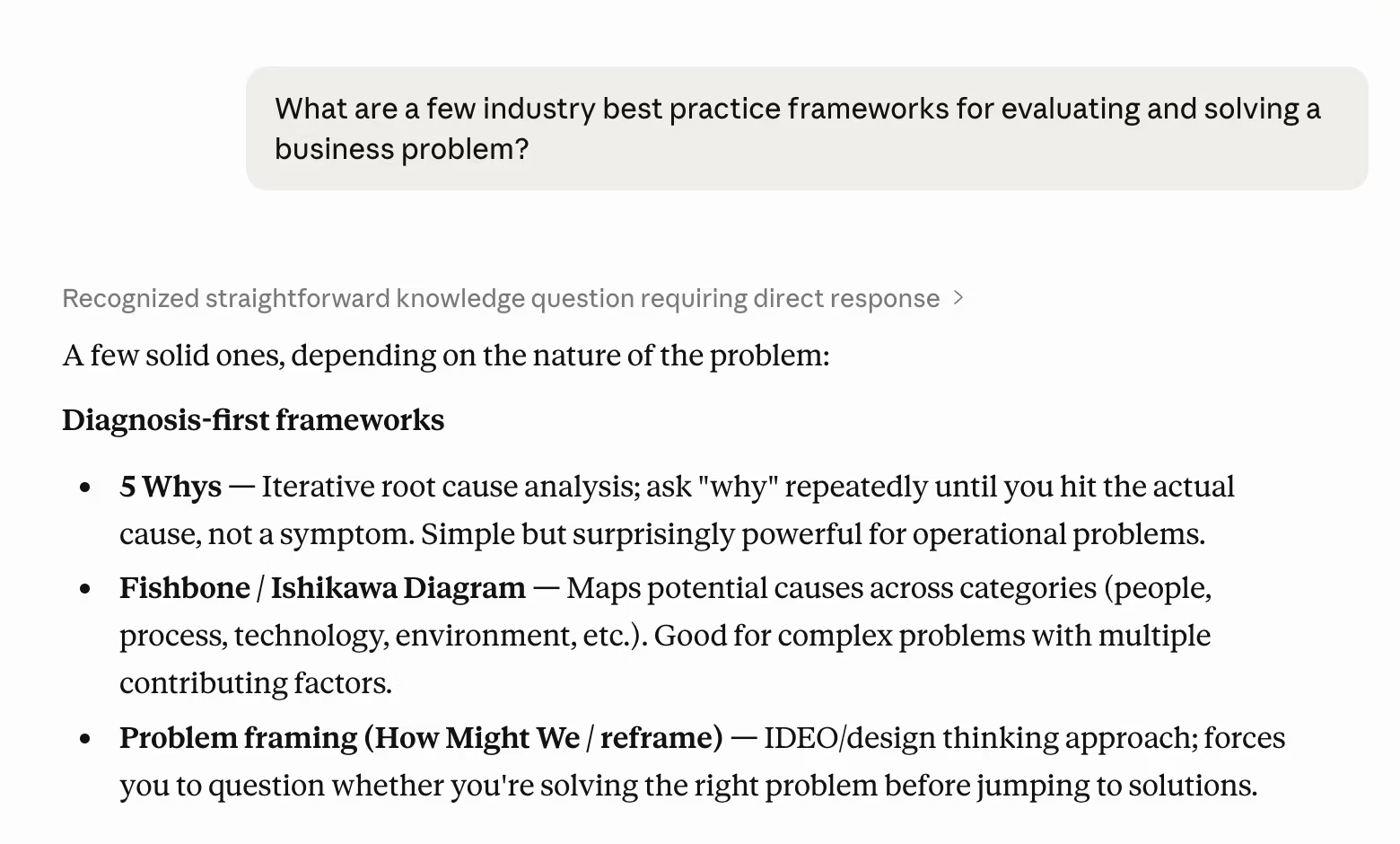
One note of caution on this approach: explicitly ask for help with the framework, not the answers to the questions. I’ve found that with clear prompting, I can get fairly good differentiation.
Here’s an example of a successful prompt:
For this session, I’d like you to act as a curious interviewer, asking questions about the idea I’m going to share with you. This is not the time to make suggestions or to critique my ideas — instead, the goal of this session is for me to explore and make explicit the current state of my own thoughts.
This prompt kept the AI tool in a facilitator role rather than a contributor role. Without it, AI tends toward proposing answers.
It can be hard to manage the distinction between using AI tools for frameworks and for solutions, but it’s a skill worth building through practice and reinforcing through deliberate prompting. Putting in the effort and using AI tools in this way can sharpen, rather than diminish, your critical thinking skills.
Pick the right tool for the job
How do you know which way to leverage your AI tools? Ask yourself:
Am I looking for something where a standard output is better?
If yes, consider using an AI tool. If not, ask a different question:
Is there a standard approach to this that might help me create a better output?
If so, don’t ask the AI to create the output; instead, ask it to guide you through best practices that facilitate your human process of creation.
------
A note on tool usage:
This post was entirely written by a human, Krissy Ferris. I provided initial drafts to the AI tool Claude with this prompt:
This is a draft blog post (I've attached the image as well). Please assess its internal consistency, clarity, and any other feedback you have to improve this piece of writing.
I then revised as I saw fit. I also used Word Hippo for thesaurus suggestions.